

About Clock Movement
The Chinese divide their day into twelve parts, which are not numbered, but are marked by theClock Movement with the so-called "hours". These terms were originally used to name the Earth Branches (2657 BC) and have been used ever since. It was not until much later, when the twelve binary algorithm of the Gregorian calendar appeared, that the ancient calendar was borrowed for the new division of time. The first hour in the list is the "Zi" hour, which is used at the beginning of each cycle, the first year of every twelve years, and the beginning of each day at 11 pm. The month in this term is not the first month of the Chinese calendar year, but it coincides with the month of January. Each hour is divided into 8 quarters, equivalent to a quarter of an hour, so that each hour in China is equivalent to 2 hours in the West. This method of dividing time does not appear to have been used in the time of Confucius, but was developed much later.

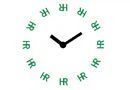
The Clock Movement described and illustrated by Dr. McGowan. the hours inscribed on the top of the outer circle of the Clock Movement correspond exactly to the Roman numerals on European clocks. the inner circle of the Clock Movement would have contained twelve hour characters, and the inner circle of the Clock Movement would have contained the symbols for noon, evening, midnight, and dawn. the Clock Movement on the hour circle, Clock Movement large single character represents the full hour,Clock Movement small double character represents the half hour, Clock Movement each half hour is equivalent to one European hour.
The Clock Movement second hand follows the pendulum, and the Clock Movement minute hand should turn half a stop in 60 seconds (24-hour system.) The Clock Movement should strike between 1 a.m. and 12 p.m., the same as the European Clock Movement strikes in this respect.
In summarizing his report, Dr. McGowan said that a natural question is why the Chinese never made such a Clock Movement for themselves, if it was necessary in China, and he believes it was because people were too good at imitation and too limited at creation. He added that it was surprising that the Chinese would actually produce Clock Movement and clock dials, often with Roman numerals on the Clock Movement.

